
Reposition & Reinvent · Redefine what exists
Brand repositioning for businesses that have outgrown their brand.
When the business evolves, the brand must keep up. We realign positioning, identity, communication and the website with what you can actually do now.
The gap
The business evolved. The brand should too.
- Seen as A supplier, when it is A partner
- Seen as A local firm, when it is A global one
- Seen as A product, when it is A system
What the business can do
New services, markets, standards and ambitions, often far broader than the brand suggests.
How the market sees it
What buyers infer from the website, the sales deck and the way others describe you.
What closes it, in order
Positioning
What the business should be known for, and by whom.
Messaging
The proposition and the proof, written for the people who buy.
Identity
Evolved or rebuilt, keeping what already earns recognition.
Website
Where buyers test the new story first.
Keep
What already carries recognition: a name, a colour, a symbol people know.
Evolve
What is right in spirit but dated in execution.
Replace
Anything that tells the old story, or no story at all.
Signals
When it is time.
Customers see a supplier when you are a partner, a local firm when you serve the world, a product when you offer a system.
- New services or markets the brand does not show
- A sales story the website does not support
- Specialist capability buyers cannot find
Who it is for
Established businesses that look smaller than they are.
Specialists who grew past their first brand
Companies whose capability, standards or markets have moved on, while the name, the identity and the website still describe the business as it was.
Businesses entering new markets
Firms selling to new sectors or new countries, where buyers meet the brand before they meet the team and judge it on what they see online.
Companies after a change
A merger, a new service line, new leadership or a new strategy that the brand does not yet explain to the people who matter.
Signs you need it
Signs the brand has fallen behind.
- Buyers are surprised by how much you do once they talk to you.
- Your sales team explains the business differently from the website.
- You win work through referrals but rarely through search.
- New services sit on the website as an afterthought, or not at all.
- Competitors with less experience look more established than you.
- Several logos, colours and styles are in use at once.
- You are preparing for a new market, a new investor or a new price point.
How it runs
Measure the gap, then close it.
Repositioning starts with a deeper look at the present, because perception has to be measured against capability before anything changes.
Assess
We review the brand and its communication as buyers see it: the website, the sales material, search results and how competitors present themselves. Where possible we hear from customers and the team. The result is a clear picture of where perception and capability part ways.
Reposition
We agree what the business should be known for, and by whom: the position, the proposition and the proof, written in the language your buyers use.
Decide what to keep
Every existing asset is sorted into keep, evolve or replace. Recognition already earned, such as a name, a colour or a symbol people know, is protected on purpose.
Rebuild the expression
The identity is evolved or rebuilt, the messaging rewritten and the website planned around how buyers now search and decide.
Roll out
Guidelines, templates and a rollout plan, so the change reaches every touchpoint in a sensible order and your team can carry it on.
What you receive
Only what needs to change.
Scoped to the business. The proposal lists what yours includes, and nothing is changed for the sake of it.
| Deliverable | What it is for |
|---|---|
| Brand and communication audit | Shows what buyers see today, and where it undersells the business. |
| Competitive landscape | Maps how competitors present themselves, so the new position is distinct. |
| Positioning | Defines what the business should be known for, and by whom. |
| Messaging architecture | Turns the position into a proposition, proof and messages for each audience. |
| Identity evolution or a new identity | Carries the new story visually, keeping what already earns recognition. |
| Website and digital presence | Gives buyers somewhere to test the new story, organised the way they search. |
| Guidelines and rollout | Keeps the change consistent as it reaches every team, supplier and touchpoint. |
Starting price
Where a repositioning starts.
From $6,500
The final cost is set in a written proposal after a first call. It follows the scope: how deep the assessment goes, whether the identity evolves or changes, and how many touchpoints the rollout covers.
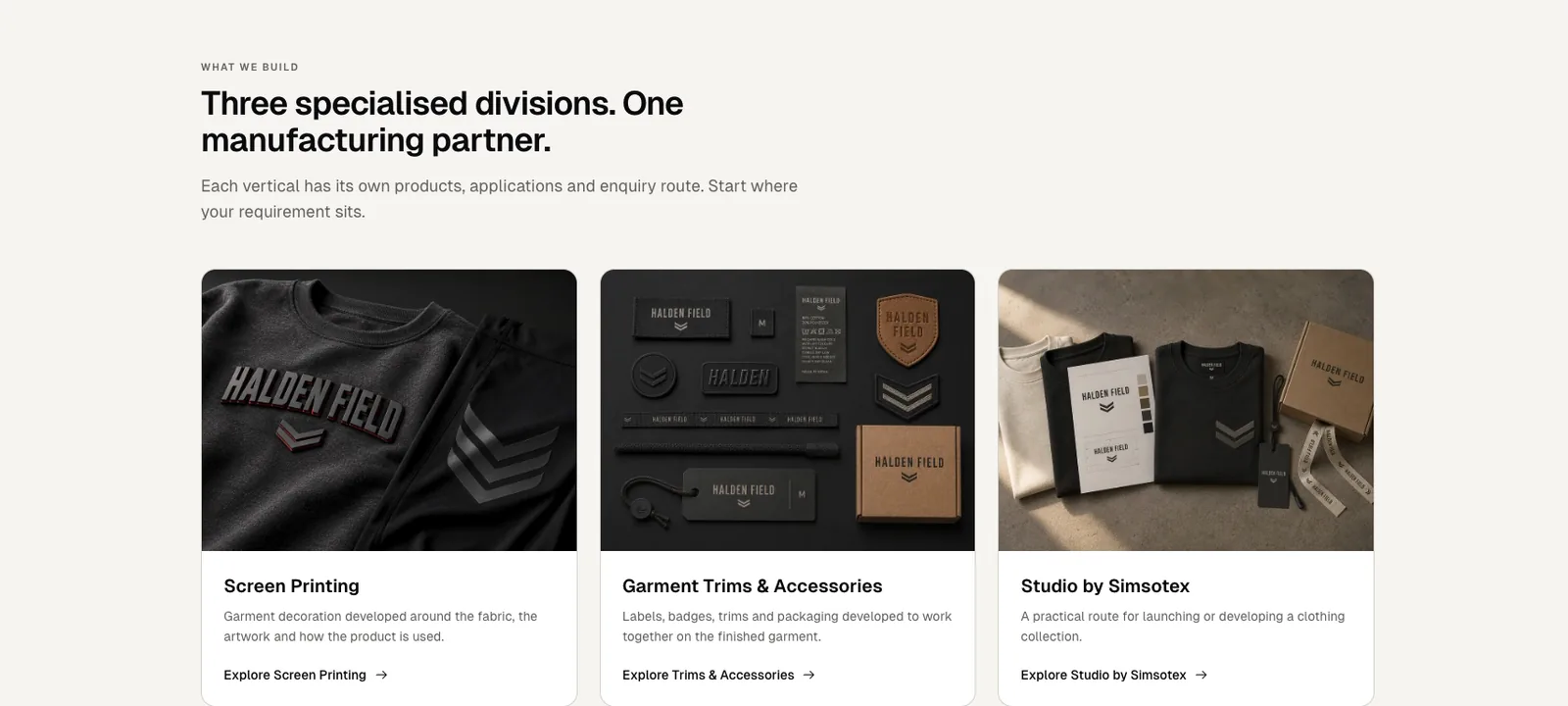
- An established apparel-branding manufacturer, in garment decoration such as screen printing and heat transfer, well before Pixnut’s work began.
- Pixnut delivered website strategy and information architecture, and organised its product, finish and industry content.
- 108 indexable pages: 11 industry, 13 product, 10 materials and finishes, 15 work pages and a 46-page resources library.
- SEO, AEO and GEO foundations and technical optimisation were built in. All 108 pages were indexed at handover.
- A website project, not a rebrand: the company’s identity predates the work.
In short
Rebranding, done for a reason.
Brand repositioning, or rebranding, is for a business whose brand no longer matches what it does. We reassess its market position, then realign the message, the brand identity and the website so the brand tells the truth about the business today. For Simsotex, an established manufacturer, the work was a website that makes its expertise visible and easy to find in search.
Pixnut is based in Bengaluru and works with established businesses in India and internationally.
Questions
Before you start.
Is repositioning the same as rebranding?
Will we lose the recognition we have built?
How do we know whether we need a refresh or a full repositioning?
Will we have to change our name?
Can you rebuild only the website?
How long does a repositioning take?
Can you work with our in-house marketing team?
Do you work with businesses outside India?
Has your business outgrown its brand?
Tell us what the business does today and how it is seen. Book a call, or take the Brand Health Check first.